01
The Same KPI Has Multiple Totals
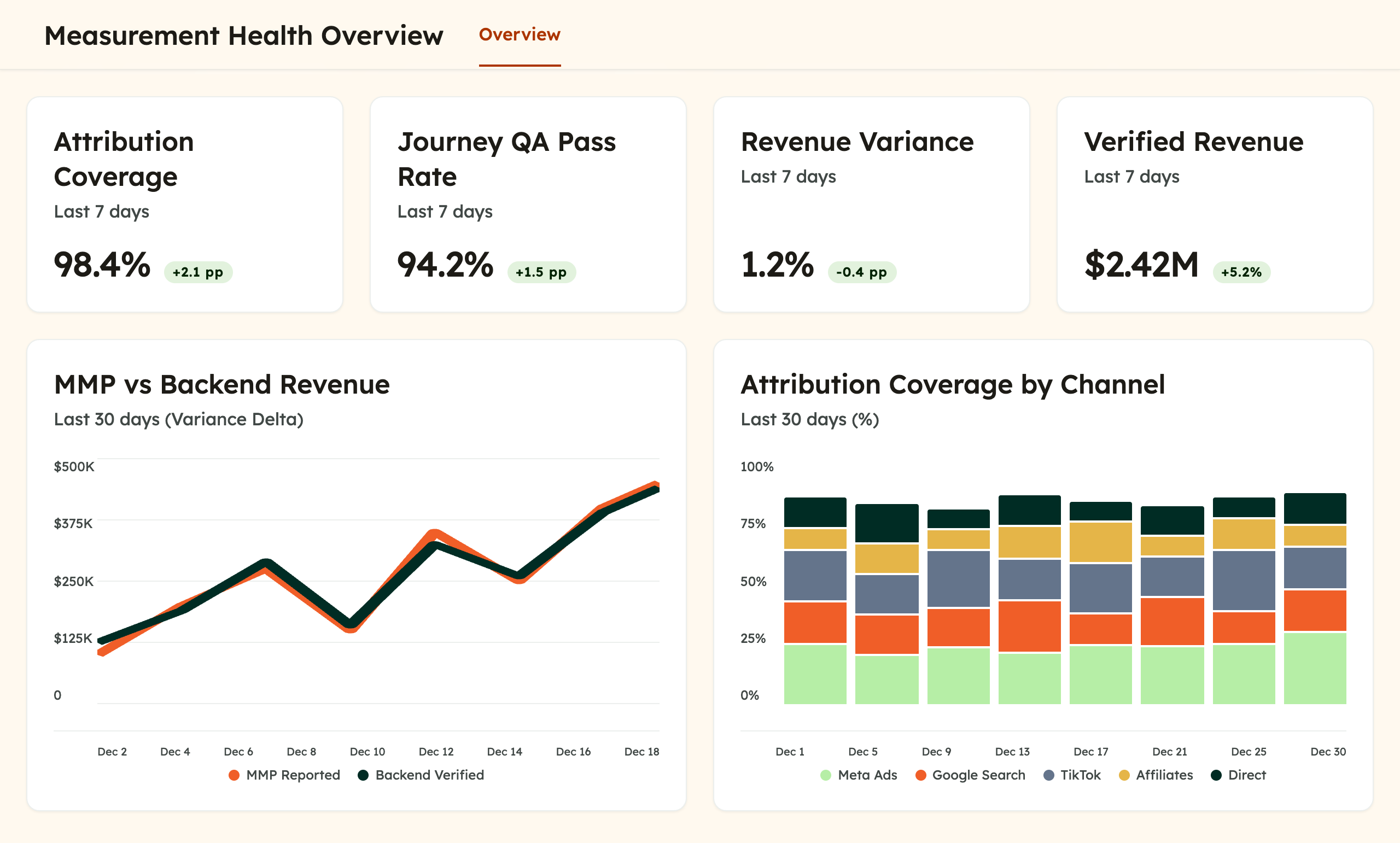
MMP, ad platform, store, product analytics, subscription, and backend systems count users, dates, attribution, and revenue differently.
Mobile Measurement, Attribution & MMP
Grovix audits, implements, and migrates the measurement layer connecting acquisition, product behavior, privacy frameworks, subscriptions, and verified revenue, so growth decisions are based on defined, tested data rather than dashboard consensus.
For growth, product, data, and engineering teams scaling paid acquisition, repairing attribution, migrating an MMP, or aligning campaign performance with downstream value.
The Decision Risk
Measurement becomes a business constraint when systems use different definitions, events lack ownership, privacy paths are blended, or teams cannot explain which number should drive the next decision.
01
MMP, ad platform, store, product analytics, subscription, and backend systems count users, dates, attribution, and revenue differently.
02
Names, triggers, properties, identifiers, and revenue rules drift across platforms until teams cannot trust or safely optimize to them.
03
ATT, SKAN, consent states, aggregation, thresholds, and postback delays are mixed into one report without their measurement limits.
The Engagement
Start with a forensic audit, a net-new implementation plan, or a migration path. Each route keeps definitions, dependencies, ownership, and acceptance evidence explicit.
Independent measurement audit, implementation specification, MMP migration, or journey validation and sign-off support.
Timing
The sequence is confirmed after the priority journeys, platforms, access, and release constraints are mapped. Audit, implementation, and migration remain explicit phases.
Our Method
The engagement starts with the decisions your teams need to make and ends with tested data contracts, owners, and acceptance rules.
We identify the acquisition, activation, retention, monetization, and lifecycle decisions the measurement system must support before changing events or dashboards.
Attribution, product behavior, store conversion, media delivery, spend, and verified revenue remain distinct, with one accountable source for each definition.
We test click, store, first open, attribution, deep link, in-app event, revenue, consent, export, and reporting behavior, not only whether an SDK initializes.
Engagement Scope
We scope the work around the channels, privacy paths, platforms, user journeys, and reporting risks that materially affect growth decisions.
Provider selection, SDK and S2S architecture, partner data sharing, attribution windows, fraud controls, migration mapping, QA plans, and cutover risk management.
Governed events, properties, triggers, user and device identifiers, revenue definitions, owners, environments, deduplication, and versioning.
Consent-state implementation review, prompt timing tradeoffs, privacy documentation inputs, event sharing, and consent-aware reporting boundaries.
Privacy-safe iOS measurement design, conversion-value or event mapping, partner setup, reporting-delay expectations, and campaign-volume constraints.
Universal or app links, deferred routing, campaign parameters, fallback behavior, owned-channel links, and device-level QA across the real journey.
Real-time callbacks, scheduled storage exports, warehouse-ready schemas, freshness checks, spend and revenue joins, discrepancy rules, and reporting ownership.
Engagement Outputs
The outcome is not another architecture diagram. It is an implementation-ready measurement plan with evidence, ownership, and explicit sign-off criteria.
An evidence-backed inventory of SDKs, events, identities, attribution settings, privacy paths, partner mappings, links, exports, dashboards, and decision-critical discrepancies.
An actionable event taxonomy, data-flow map, source-of-truth matrix, QA cases, suggested ownership, dependencies, and rollout sequence.
Representative user journeys tested across systems by definition, timezone, window, cohort, event source, consent state, and data freshness, with acceptance evidence.
A senior-led step with a clear owner and decision rule.
A senior-led step with a clear owner and decision rule.
A senior-led step with a clear owner and decision rule.
A senior-led step with a clear owner and decision rule.
Engagement Fit
The engagement works across new implementations, migrations, and forensic audits where attribution or downstream-value uncertainty is blocking confident optimization.
Good fit · 01
Marketing and product teams report different acquisition, activation, or revenue numbers.
Good fit · 02
You are implementing or migrating Adjust, AppsFlyer, Branch, or another MMP.
Good fit · 03
iOS privacy changes have made campaign quality, attribution, or SKAN reporting hard to interpret.
Good fit · 04
Deep links, partner events, subscriptions, raw exports, or warehouse joins fail in parts of the real user journey.
Measurement
The first outcome is knowing which data is complete, timely, correctly defined, and fit for each decision before campaign or product teams optimize against it.
Event completeness, schema validity, duplicate rate, identity coverage, revenue reconciliation, environment leakage, and SDK or S2S consistency.
Paid and owned source coverage, partner mappings, window logic, organic classification, reattribution, consent state, and privacy-framework reporting.
Data freshness, export success, dashboard latency, broken-link rate, QA pass rate, documented ownership, and time required to resolve discrepancies.
Attribution is a rules-based allocation of credit, not proof of causality. We keep platform delivery, MMP attribution, product behavior, store conversion, and verified backend transactions distinct, then reconcile them for the decision at hand.
Start with a senior-led audit of your measurement architecture, attribution rules, event taxonomy, privacy paths, and highest-risk user journeys.
Request a Mobile Measurement Audit